
Non-contact surface measuring instruments
Overview
Surface measurement is essential in precision manufacturing. Instrument choice depends on required resolution, material type, working distance, and surface properties. This document summarizes key sensing technologies used to measure surface profiles and distances.
Technology Comparison at a Glance
| Technology | Principle | Strengths | Limitations | Best Use Cases |
| Inductive Sensor | Electromagnetic field interaction with metal | High axial resolution (<1 µm), compact, cost-effective | Only works on metals, short range (<20 mm), poor lateral resolution | Metal displacement, industrial positioning |
| Capacitive Sensor | Capacitance variation between sensor and target | Extremely high axial resolution (nm-level), stable vs. micro-textures | Limited range (~10 mm), large sensing area required, sensitive to material type | Semiconductor inspection, precision thickness |
| Ultrasonic Sensor | Acoustic pulse time-of-flight | Works with all materials, long range (>100 mm), compact | Low resolution (~0.5 mm), wide beam | Bulk distance measurement, level sensing |
| Radar Sensor | Radio wave time-of-flight | Similar to ultrasonic but more robust in harsh environments | Low resolution (mm-range) | Long-range detection, industrial monitoring |
| Laser Triangulation | Position of reflected laser spot | Cost-effective, scalable to long range (>100 mm) | Requires diffuse surfaces, sensitive to reflections | General-purpose surface profiling |
| Confocal Chromatic | Wavelength-dependent focal distance | High axial (<1 µm) & good lateral resolution, works on various surfaces | Sensitive to micro-structures, cannot measure small thickness, higher cost | Precision surface metrology, mixed materials |
| White Light Interferometry | Low coherence optical interference | Very high axial resolution (< 10 nm), even on stacked materials, works on various surfaces | Sensitive to micro-structures, limited vertical range practicality, high cost | Ultra-precision surface height, small gaps and stacks |
Measurement Principles
Inductive Sensor
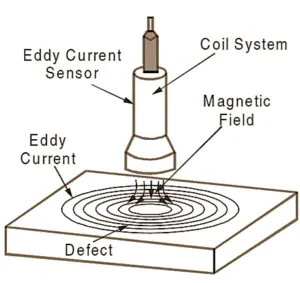
An inductive sensor generates a high-frequency electromagnetic field with a coil. When a metal target enters that field, it induces small circulating currents (eddy currents) in the metal, which change the sensor’s own electrical signal. The closer the metal, the bigger the change, so the sensor converts this into a precise distance reading.
Capacitive Sensor
A capacitive sensor and the target surface act like the two plates of a capacitor. As the distance between them changes, so does the capacitance between them, in a very predictable way. By measuring that capacitance, the sensor calculates the gap with extremely fine, nanometer-level precision, though only over a very short range.
Ultrasonic Sensor
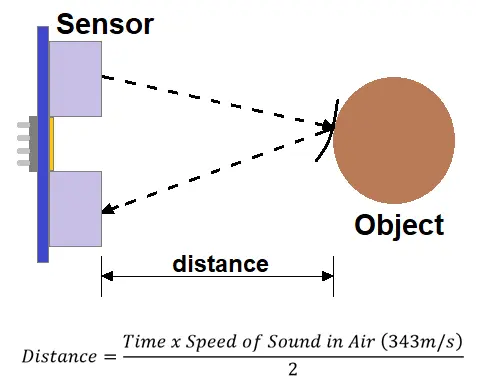
An ultrasonic sensor sends out a short pulse of sound above human hearing range and listens for its echo bouncing back off the target. Since sound travels at a known, constant speed in air, the time it takes for the echo to return tells the sensor how far away the surface is, this is called “time-of-flight.”
Radar Sensor
Radar sensors use the same time-of-flight idea as ultrasonic sensors, but with radio waves instead of sound. A radio wave is sent toward the target and reflected back; measuring the travel time (or frequency shift) gives the distance. Because radio waves aren’t affected by dust, steam, or temperature the way sound is, radar tends to be more robust in harsh environments.
Laser Triangulation
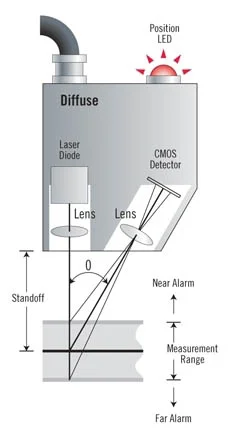
A laser triangulation sensor projects a laser spot onto the surface, and a detector placed at a known angle observes where that spot lands. As the surface moves closer or farther away, the reflected spot shifts position on the detector. Using simple geometry between the laser, the surface, and the detector, the sensor calculates the distance.
Confocal Chromatic
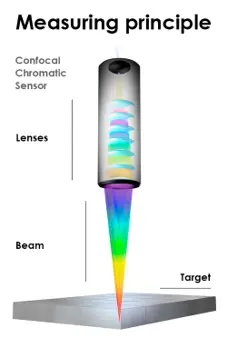
This sensor shines white light through a lens that spreads its colors apart, so each color comes into sharp focus at a slightly different distance. Only the one color that focuses exactly on the target surface reflects strongly back into the sensor. By identifying that color, the sensor knows precisely how far away the surface is, with no moving parts.
White Light Interferometry
Light is split into two paths: one bounces off the target surface, the other off an internal reference mirror. When the two beams recombine, they create a pattern of light and dark bands that depends on the tiny difference in distance traveled. Analyzing this pattern reconstructs the surface height with sub-nanometer accuracy.
Key Selection Criteria
1. Resolution Requirements
- Nanometer scale → Capacitive or White Light Interferometry
- Micrometer scale → Inductive or Confocal Chromatic
- Millimeter scale → Ultrasonic or Radar
2. Material Compatibility
- Metal-only → Inductive
- Insulating surfaces → Capacitive
- Any material → Ultrasonic, Radar, Optical methods
3. Surface Properties
- Diffuse surfaces → Laser Triangulation
- Reflective & complex surfaces → Confocal Chromatic, Interferometry
4. Measurement Distance
- Short (<20 mm) → Inductive, Capacitive
- Medium (10–100 mm) → Optical methods
- Long (>100 mm) → Ultrasonic, Radar
5. Cost vs. Performance
- Low cost → Inductive, Ultrasonic, Triangulation
- High precision / higher cost → Confocal, Interferometry
Technology Positioning
- High Precision Metrology:
White Light Interferometry, Confocal Chromatic - Industrial Precision Sensing:
Inductive, Capacitive - General-Purpose Optical Measurement:
Laser Triangulation - Long-Range / Harsh Environment Detection:
Ultrasonic, Radar
Conclusion
No single technology fits all applications.
- Contactless optical techniques dominate precision surface measurement.
- Electromagnetic sensors excel in compact, cost-sensitive industrial uses.
- Wave-based sensors (ultrasonic/radar) prioritize range over accuracy.
Optimal selection requires balancing resolution, material compatibility, working distance, and cost constraints.